Financial institutions in Singapore are expected to penetration test their internet-facing systems at least once a year. That expectation comes from the Monetary Authority of Singapore (MAS) Technology Risk Management Guidelines, and it is often confused with the legally binding MAS Notices on technology risk and cyber hygiene. This article sets out what each document says, with links to the MAS sources.
In short
- The penetration-testing expectations are in section 13 of the MAS Technology Risk Management (TRM) Guidelines, January 2021.
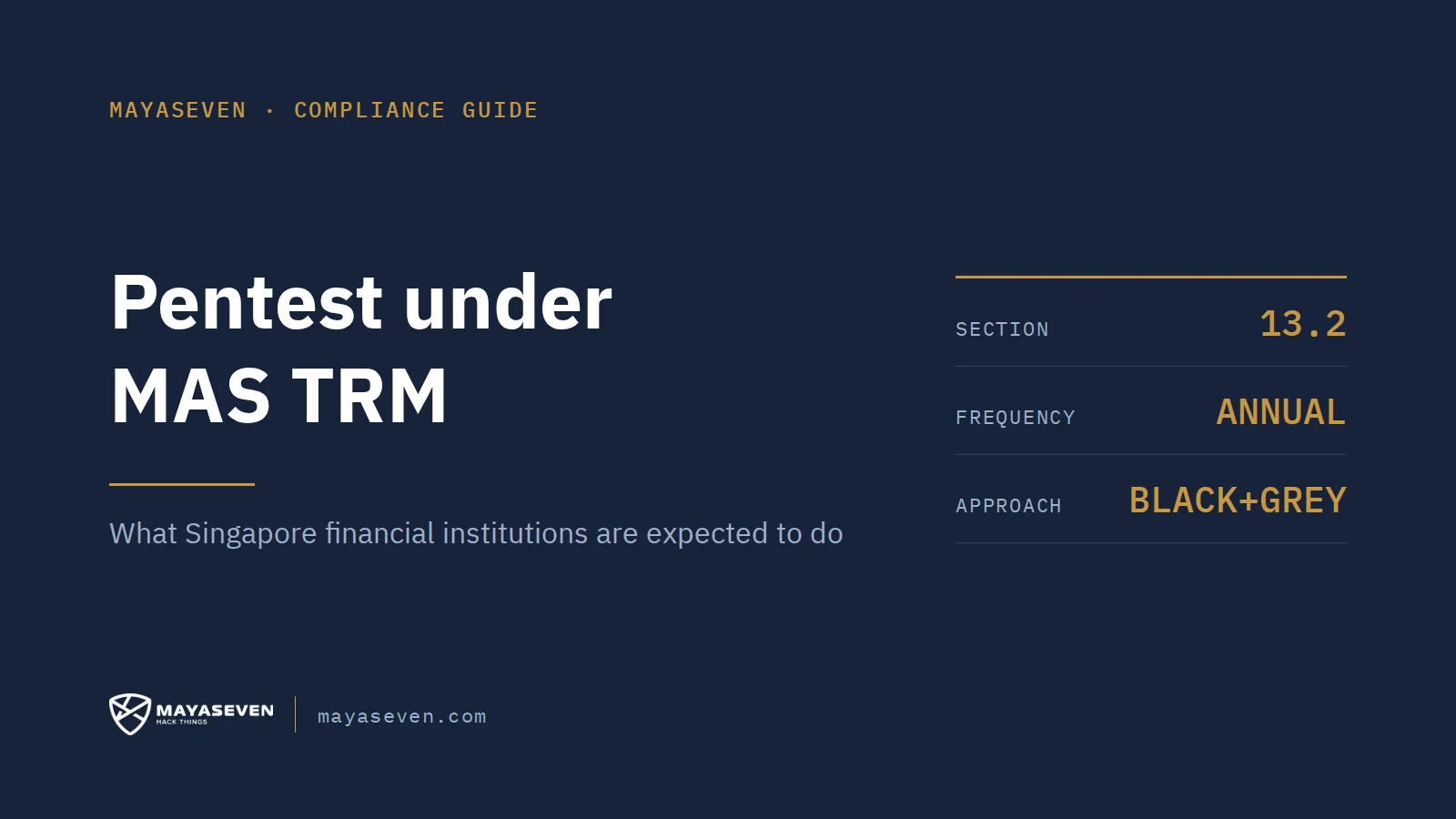
- For systems directly accessible from the internet, the FI is expected to conduct penetration testing at least once annually or whenever these systems undergo major changes or updates (paragraph 13.2.4).
- Online financial services should get a combination of blackbox and greybox testing, and testing should be on the production environment (13.2.1 and 13.2.3).
- The Guidelines are not legally binding. The binding instruments are the FSM Notices on Technology Risk Management and Cyber Hygiene, and the two bank Notices do not mention penetration testing.
- Red teaming is covered in 13.4 as an adversarial attack simulation exercise. The industry guideline from the Association of Banks in Singapore recommends one at least every 24 months.
Guidelines and Notices are different instruments
MAS describes its regulatory instruments on its own site. Notices “primarily impose legally binding requirements on a specified class of financial institutions or persons.” Guidelines “set out principles or ‘best practice standards’”, and MAS adds:
“Contravening guidelines is not a criminal offence and does not attract civil penalties, but specified institutions or persons should observe the spirit of these guidelines. How well an institution or person observes the guidelines may have an impact on MAS’ overall risk assessment of that institution or person.”
The TRM Guidelines say the same about themselves in paragraph 2.2: “In supervising an FI, the degree of observance with the spirit of the Guidelines by an FI is an area of consideration by MAS.” So the annual penetration test is a supervisory expectation, not a statutory requirement, and the extent of implementation should be “commensurate with the level of risk and complexity” of the institution.
What section 13 of the TRM Guidelines says
| Paragraph | Topic | What it says |
|---|---|---|
| 13.1.1 and 13.1.2 | Vulnerability assessment | Regular VA, at a frequency commensurate with the criticality of the system and its exposure. Scope should minimally include vulnerability discovery, weak security configurations, open network ports and application vulnerabilities. |
| 13.2.1 | Penetration testing | PT to obtain an in-depth evaluation of cyber security defences. A combination of blackbox and greybox testing for online financial services. |
| 13.2.2 | Bug bounty | An FI may consider a bug bounty programme to complement its PT. |
| 13.2.3 | Environment | PT should be conducted on the production environment, with proper safeguards. |
| 13.2.4 | Frequency | Based on system criticality and exposure. For systems directly accessible from the internet, at least once annually or on major changes or updates. |
| 13.3 | Cyber exercises | Regular scenario-based exercises, which could include social engineering, table-top or cyber range exercises. |
| 13.4 | Adversarial attack simulation | An exercise to test and validate cyber defence and response against prevalent threats, with objectives, scope and rules of engagement defined first. |
| 13.5 | Intelligence-based scenario design | Threat scenarios should be challenging but plausible, and can use threat intelligence relevant to the FI. |
| 13.6.1 | Remediation management | A process to track and resolve issues, covering severity classification, remediation timeframes by severity, and how deviations are risk-assessed. |
Frequency: paragraph 13.2.4
“The frequency of PT should be determined based on factors such as system criticality and the system’s exposure to cyber risks. For systems that are directly accessible from the Internet, the FI is expected to conduct PT to validate the adequacy of the security controls at least once annually or whenever these systems undergo major changes or updates.”
Two points follow from the wording. Section 13 uses “should” almost throughout, and “is expected to” appears only here, for internet-accessible systems. For systems that are not internet-facing, the Guidelines set no fixed interval; the frequency is risk-based.
Blackbox and greybox: paragraph 13.2.1
“The FI should carry out penetration testing (PT) to obtain an in-depth evaluation of its cyber security defences. A combination of blackbox and greybox testing should be conducted for online financial services.”
A footnote defines the terms. Blackbox testing is “testing without any prior knowledge of the environment except for the IP address ranges and known URLs”. Greybox testing is “testing with credentials”, where “the security assessor is authenticated using the same rights as a normal customer.” In practice this means an internet banking or mobile app test needs test accounts, not only an unauthenticated scan of the login page. Our pages on web application and mobile application penetration testing explain how the approaches differ.
Production environment: paragraph 13.2.3
“To obtain a more accurate assessment of the robustness of the FI’s security measures, PT should be conducted on the production environment. Proper safeguards should be implemented when PT is conducted on the production environment.”
Remediation: paragraph 13.6.1
Findings are expected to go into a tracked remediation process that minimally includes “(a) severity assessment and classification of an issue; (b) timeframe to remediate issues of different severity; and (c) risk assessment and mitigation strategies to manage deviations from the framework.”
What the binding Notices require
On 10 May 2024, MAS cancelled the older Notices 644 (Technology Risk Management) and 655 (Cyber Hygiene) and reissued them under the Financial Services and Markets Act 2022. For banks, the current instruments are Notice FSM-N05 and Notice FSM-N06. Other sectors have their own pairs in the FSM-N03 to FSM-N26 series, for example FSM-N03 and FSM-N04 for insurers.
Notice FSM-N06 (Cyber Hygiene) sets six requirements for banks: securing administrative accounts, applying security patches within a timeframe commensurate with the risk, written security standards for every system, network perimeter defence, malware protection, and multi-factor authentication for administrative accounts on critical systems and for accounts that access customer information through the internet.
Notice FSM-N05 (Technology Risk Management) requires a bank to identify its critical systems, keep unscheduled downtime of each critical system to no more than 4 hours in any 12 months, set a recovery time objective of not more than 4 hours, notify MAS within 1 hour of discovering a relevant incident, submit a root cause and impact analysis within 14 days, and protect customer information from unauthorised access or disclosure.
Neither bank Notice contains a penetration-testing requirement. We read FSM-N05 and FSM-N06 in full; we did not read the Notices for other sectors, so check the Notice that applies to your licence type.
Red teaming: adversarial attack simulation exercises
Paragraph 13.4.1 of the TRM Guidelines says an FI “should perform an adversarial attack simulation exercise to test and validate the effectiveness of its cyber defence and response plan against prevalent cyber threats.” The Guidelines do not set a frequency.
The industry reference is published by the Association of Banks in Singapore (ABS), not by MAS. The current edition is “Red Team: Adversarial Attack Simulation Exercise Guidelines for the Financial Industry in Singapore”, version 2.0, September 2024. It recommends that an exercise “be performed once every 24 months minimally”, with the flexibility to move to every 12 months. It also contrasts the two activities: a penetration test aims “to identify as many vulnerabilities as possible, in a limited scope” and is known to all stakeholders, while an adversarial attack simulation is objective-based, covert, and targets people, process and technology. ABS also publishes Penetration Testing Guidelines 2.0 (April 2024). See our red teaming page for how such an exercise runs.
Who the TRM Guidelines apply to
The MAS page for the Guidelines lists the institution types they apply to. The list includes banks (full, wholesale and merchant), finance companies, insurers and reinsurers, insurance brokers, capital markets intermediaries and fund management companies, exchanges and clearing houses, licensed trust companies, financial advisers, credit and charge card issuers, and payment institutions (major and standard). Check the “Applies to” list on the MAS page for your own licence type.
A checklist for FIs in Singapore
- Keep an inventory of systems that are directly accessible from the internet, and penetration test each one at least annually and on major changes.
- Use both blackbox and greybox testing for online financial services, with test accounts that have normal customer rights.
- Test on production where possible, with safeguards agreed in advance.
- Run vulnerability assessments at a frequency that matches each system’s criticality and exposure.
- Put findings into a remediation process with severity classes and timeframes, and retest.
- Plan an adversarial attack simulation exercise, and separate it from routine penetration testing.
- Meet the binding FSM Notices for your sector independently of the Guidelines.
How MAYASEVEN can help
MAYASEVEN is an offensive security firm with offices in Singapore and Bangkok. We provide penetration testing and red teaming as an independent external tester. Every finding in our reports is verified by an expert and comes with a CVSS score, a proof-of-concept, business impact and remediation guidance, and a retest is included. The company is certified to ISO/IEC 27001:2022. Contact our team to discuss scope.
Sources
- MAS: Guidelines on Risk Management Practices – Technology Risk (page, with the “Applies to” list)
- MAS Technology Risk Management Guidelines, January 2021 (PDF)
- MAS: Supervisory Approach and Regulatory Instruments
- MAS Notice FSM-N05: Technology Risk Management (banks)
- MAS Notice FSM-N06: Cyber Hygiene (banks)
- MAS Notice 655: Cyber Hygiene (cancelled with effect from 10 May 2024)
- Association of Banks in Singapore: cyber security industry guidelines (Red Team AASE Guidelines v2.0 and Penetration Testing Guidelines 2.0)
This article summarises documents published on the MAS and ABS websites as at 17 November 2026 to give an overview. It is not legal or compliance advice. Check the full and latest text of each document, or consult your compliance function.